
Criminal Court Records in Cibola County
A criminal court record is the case-level file kept by the court clerk after a criminal complaint, information, indictment, citation, or related charging document reaches court. It can show the defendant, filed charges, court location, case number, bond orders, hearings, motions, plea, dismissal, conviction, sentence, probation terms, and financial obligations. For the narrower arrest-to-charge pathway, use arrest records and court charges; for the broader public case-access route, use the general court-record search process.
Cibola County District Court is part of the Thirteenth Judicial District and handles felony criminal cases after charging and preliminary stages. Cibola County Magistrate Court handles misdemeanors, DWI/DUI, traffic, and felony preliminary proceedings. Grants Municipal Court and Milan Municipal Court handle municipal ordinance, traffic, petty misdemeanor, and DWI/DUI matters that arise inside city or village limits. New Mexico Courts states that municipal court data in Case Lookup is limited to criminal Domestic Violence and DWI historic convictions beginning September 1, 1991.
How to Search Cibola County Criminal Court Records
Start with New Mexico Case Lookup for public electronic case data. The portal supports name search, case number search, and a DWI search. A defendant-name search can be narrowed by court type, court location, case category, and filing or hearing date. Cibola-relevant court-location options captured in the research include District 1333 - Grants, Magistrate 61 - Grants, Municipal 94 - Grants, and Municipal 121 - Milan.
- Open New Mexico Case Lookup and accept the disclaimer for individual public record viewing.
- Search by defendant name when the case number is unknown, using Last First Middle format where possible.
- Use Case Number Search when the complete court type, location, category, and number are known.
- Use DWI Search when checking historic DWI conviction information rather than a general criminal case.
- Use re:SearchNM, the court clerk, or New Mexico Courts IPRA when actual documents, certified copies, or older records are needed.
New Mexico Courts IPRA states that courts do not conduct public criminal background checks and do not maintain law-enforcement records. A court record search can show court case information, but it is not the same as a DPS background check, a sheriff report, a jail roster, or an MVD driver record.
The New Mexico DPS Law Enforcement Records Bureau is the source for statewide criminal-record and law-enforcement-record context.
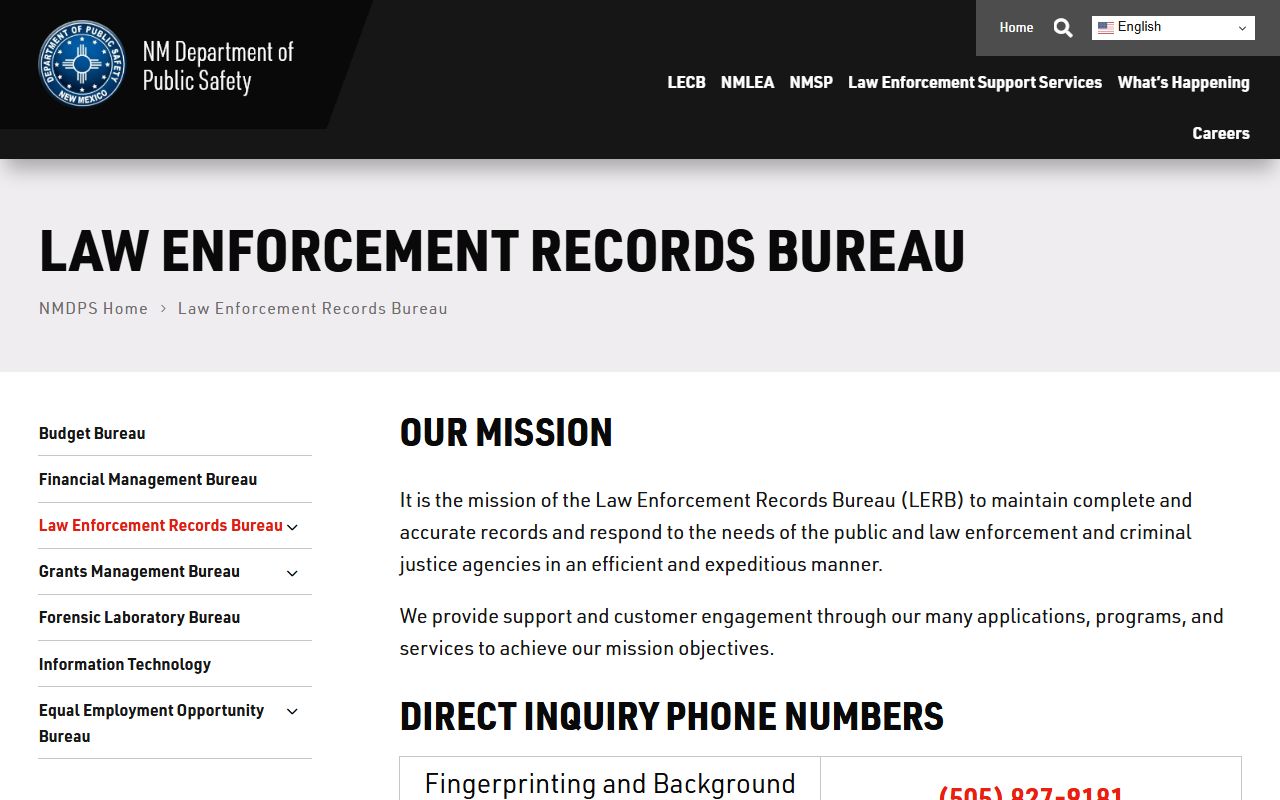
DPS material is useful for statewide criminal-history context, but Cibola court case files still come from the court where the case was filed.
Stages of a Criminal Case
A criminal case record changes as the case moves. Early entries may show the complaint, charge, arrest warrant, summons, bond, or first appearance. Later entries may show arraignment, pretrial settings, motions, plea negotiations, trial settings, dismissal, conviction, sentence, probation, restitution, costs, and compliance events. The docket is the timeline; the full case file includes the filed documents when access is allowed.
Case flow: Charges Filed › Arraignment › Pretrial / Motions › Plea or Trial › Disposition › Sentencing
| Stage | What Happens |
|---|---|
| Charges Filed | A complaint, information, indictment, or citation identifies the alleged offense and starts the court record. |
| Arraignment | The defendant is advised of the charge and rights, and a plea or future setting may be entered. |
| Pretrial / Motions | The record may show discovery, continuances, suppression motions, status conferences, or plea negotiations. |
| Plea or Trial | The case may resolve by plea, dismissal, acquittal, conviction, or trial verdict. |
| Sentencing | The judgment and sentence may list incarceration, probation, fines, fees, restitution, treatment, or other terms. |
The New Mexico DPS expungement page is the source for criminal-record expungement information.
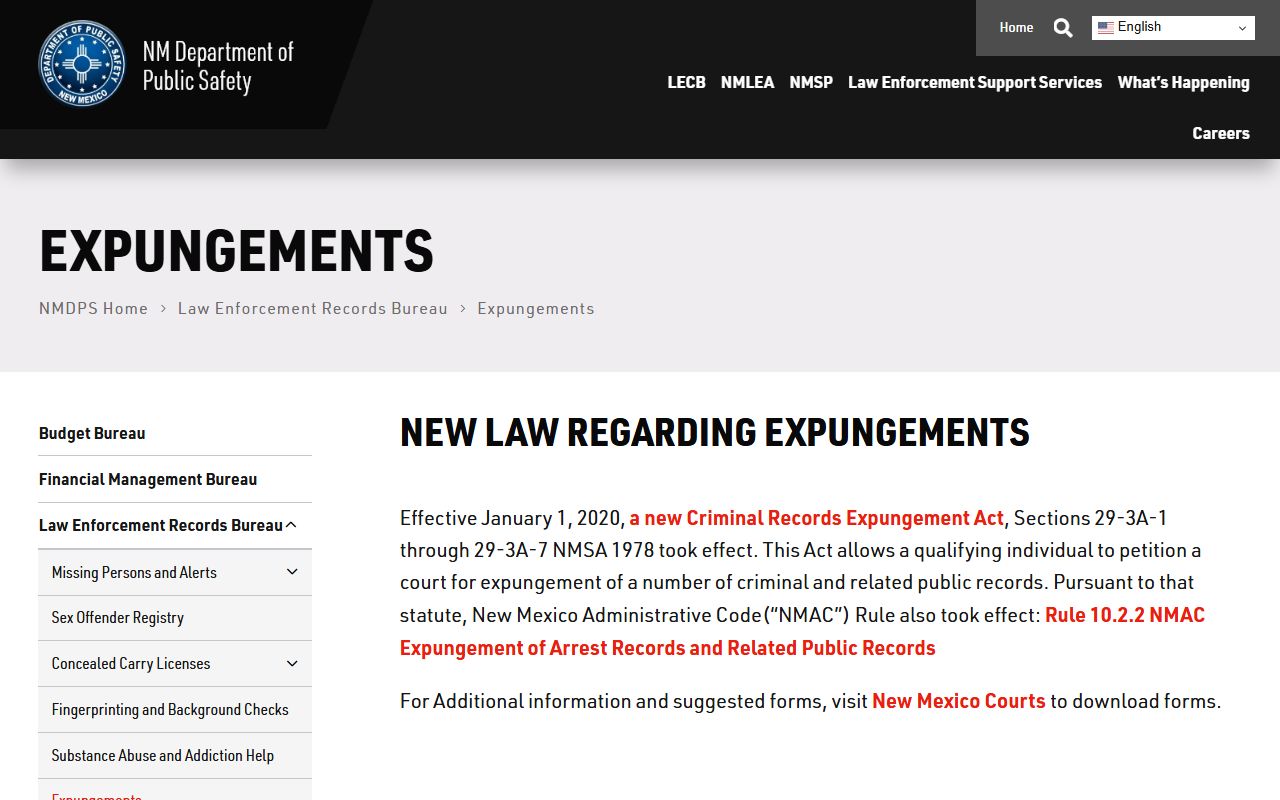
Expungement rules matter because some criminal court records that once appeared publicly may later become restricted by court order.
What a Cibola County Criminal Court Record Shows
Typical criminal case data can include the court type and location, case number, case category, defendant name, filing date, hearing dates, docket entries, and case status. Criminal-specific entries may include charges, pleas, bond orders, warrant or failure-to-appear connections, dispositions, judgments, sentences, probation terms, and fine or fee information. Public Case Lookup does not provide documents, and PII such as Social Security numbers and address information is not displayed.
| Field | What It Shows |
|---|---|
| Case Number | The court's tracking number, broken into court type, location, category, and case number in Case Lookup. |
| Defendant | The person charged in the criminal case. |
| Charges | The alleged offenses filed in court; charges can be amended, reduced, dismissed, or resolved later. |
| Bond / Release | Release conditions, bond settings, or custody-related court orders when entered. |
| Plea | The defendant's formal response, such as guilty, not guilty, or other plea entry where shown. |
| Disposition | The outcome of the case or individual charge, including dismissal, conviction, acquittal, or other resolution. |
| Sentence | Probation, incarceration, fines, fees, restitution, treatment, or other terms after conviction. |
Prosecutor and Public Defender Records
The Thirteenth Judicial District Attorney's Office serves Cibola, Valencia, and Sandoval Counties. The Cibola office lists J. Michael Thomas as Deputy District Attorney, with street address 700 E. Roosevelt Avenue, Suite 30, Grants, NM 87020, phone 505-285-4627, and fax 505-285-4629. District Attorney Barbara Romo's office determines whether and how referred charges proceed in court, so a court record may differ from the first arrest or booking label.
The New Mexico Law Offices of the Public Defender handles appointed defense representation. If a person is jailed and the court appoints a public defender, assignment is automatic and counsel arranges a meeting when possible. If a defendant is not jailed, LOPD instructions say to apply at the closest public defender office with a $10 cash or money order application cost, proof of income, and proof of government assistance if applicable. Public-defender files are not public search records for private users; the public value is understanding why appointed counsel may appear in the court docket.
The Thirteenth Judicial District Attorney Cibola office page is the source for the local prosecutor contact image.
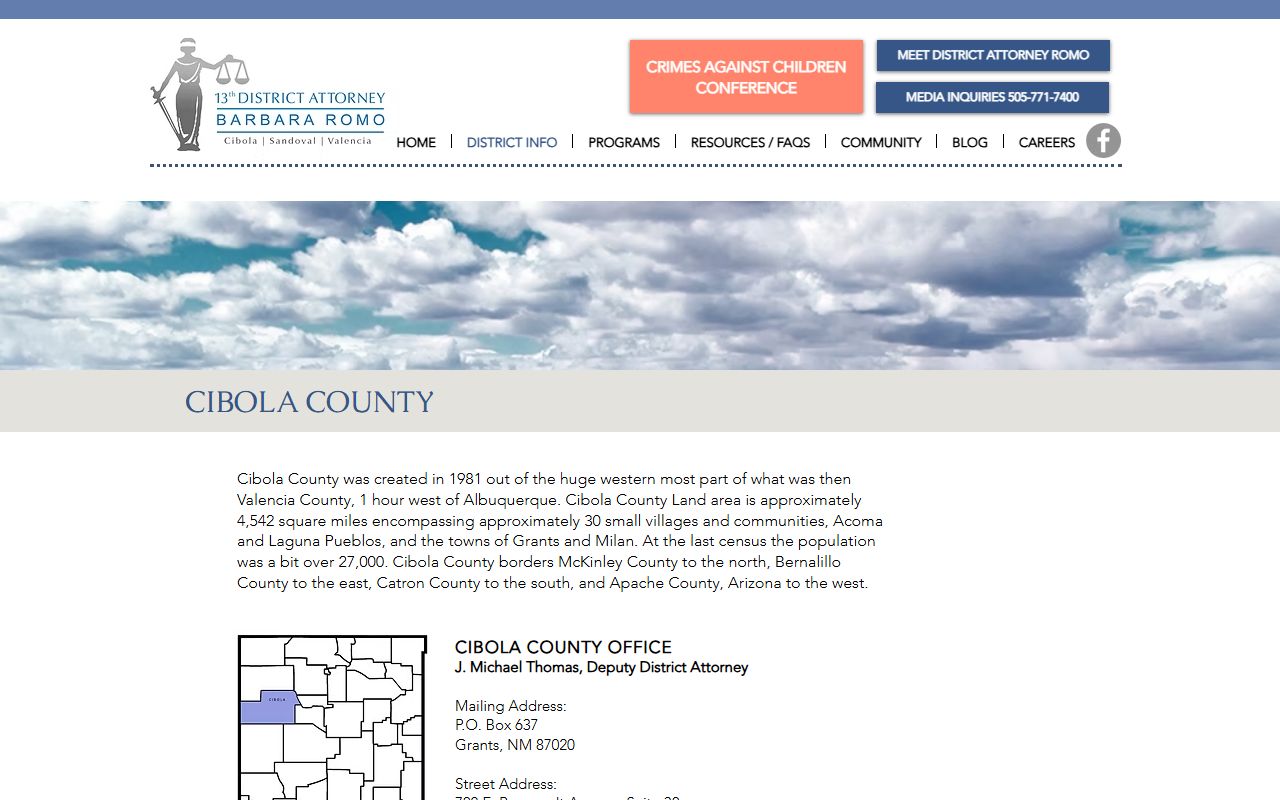
The DA contact is central to criminal records because prosecution decisions determine whether a referred arrest becomes a filed court charge.
Charges vs. Convictions
A charge is an accusation filed in court. A conviction is a later outcome after a guilty plea, verdict, or other qualifying finding. Cibola criminal court records can show charges that were dismissed, reduced, amended, or resolved without conviction. For that reason, search results should be read by charge status and disposition rather than by the first charge label alone.
| Charge | Conviction | |
|---|---|---|
| Stage | Accusation filed or alleged in court | Outcome by plea, verdict, or finding |
| Record Meaning | Shows what was alleged or prosecuted | Shows criminal guilt for that charge |
| Can Change | May be amended, reduced, added, or dismissed | May lead to sentence, probation, fines, or appeal |
Reading Dispositions and Sentences
Disposition means the outcome of a case or charge. The research glossary identifies dismissal, conviction, judgment, sentence, probation, restitution, bond, bench warrant, arraignment, indictment, information, complaint, dismissed with prejudice, and dismissed without prejudice as useful terms for reading New Mexico criminal records. A sentence is the punishment or conditions imposed after conviction. Probation is court-ordered supervision instead of or after incarceration, while restitution is payment ordered to compensate a victim.
Sealed vs. Expunged Records
Sealed records are restricted from ordinary public access. Expunged records are limited by a court order under the Criminal Records Expungement Act, but the New Mexico Supreme Court expungement handout described in the research notes that criminal records are not destroyed and remain available for future criminal proceedings and some regulated-employment purposes. Federal and tribal records cannot be expunged under the New Mexico Criminal Record Expungement Act.
| Sealed | Expunged | |
|---|---|---|
| Visibility | Restricted from ordinary public access | Public release limited by expungement order |
| Record Existence | Still exists in court or agency custody | Not destroyed under the New Mexico handout summarized in research |
| Eligibility | Depends on case type, court order, and access policy | Qualifying arrests or convictions may be petitioned under Sections 29-3A-1 through 29-3A-7 |
Public Access to Criminal Court Records
New Mexico public-record access is governed by the Inspection of Public Records Act and court access policies. The public can inspect many court records, but online court access is narrower than courthouse access and does not include every document or every case type. New Mexico Courts IPRA is the formal request path for court records when public electronic access is not enough.
Key Statutes and Policies:
NMSA 1978, Section 14-2-8(D) - written requests must identify the requester and describe records with reasonable particularity.
Criminal Record Expungement Act - qualifying people may petition a court to expunge certain arrest and public criminal records.
Background Check Considerations
A court case search is not a consumer background check and is not a complete law-enforcement criminal history. New Mexico Courts IPRA states that courts do not conduct public criminal background checks. DPS and other authorized channels may handle criminal-history records, while court files show what happened in a particular court case.
Important: Court case records should not be used for credit, employment, tenant screening, insurance, or other FCRA-regulated decisions.
Restricted Criminal Court Records in Cibola County
Juvenile criminal cases have not been displayed on Case Lookup since July 1, 2007. Family Violence Protection Act order-of-protection cases have not been displayed since July 1, 2008. Sealed, expunged, confidential, adoption, abuse/neglect, FINS, and mental health case categories are restricted by policy, case type, or user role. A no-result search is not proof that a criminal matter never existed, especially if the case is restricted, older than online coverage, federal, tribal, municipal outside the displayed categories, or held by a law-enforcement agency rather than a court.
The New Mexico Law Offices of the Public Defender offices page is the source for defense-resource information.
Public defender information helps explain appointed-counsel entries in criminal dockets without turning defense files into public search records.